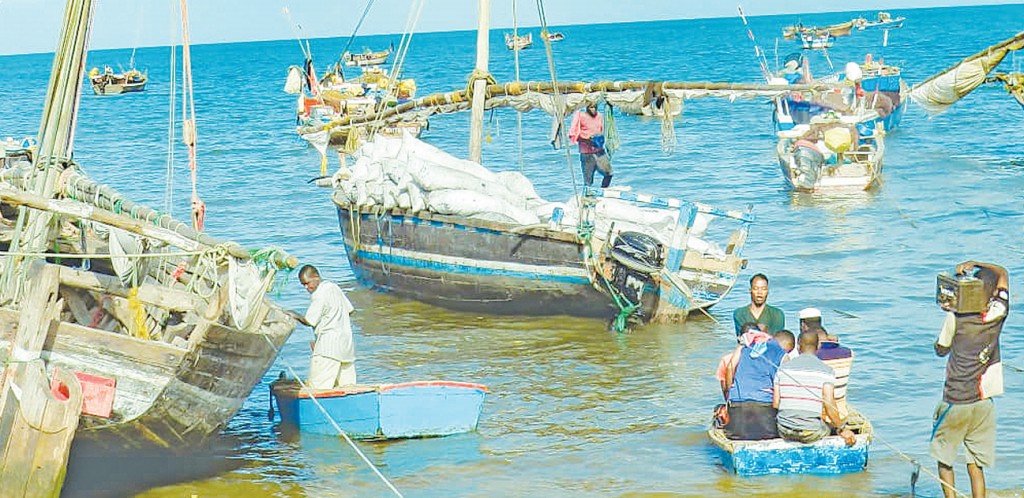
TPA Management has taken initial steps by stationing its officials, who are tasked with a collection of revenues from dhows docking at those areas. According to Mr. Ngaile, initially the TPA set up six Point of Sales but only four returned positive results in terms of cargo business and the revenue generated.
"Instead of cracking down on unscrupulous businessmen who use unofficial ports, we decided to go to those entry points and turn them into official ports," reveals Acting Manager of Tanga Port, Mr. Donald Ngaile. "By doing so, we have managed to increase compliance among businessmen and many of them are paying port dues and charges accordingly," adds Mr. Ngaile.
"After a weeklong assessment of cargo movement in targeted areas we decided to withdraw two of them our plans and maintained three POS," say the Tanga Port Acting Manager.
The Government's decision, which is based on a study conducted by the Tanga Port Management on unofficial ports along the Tanga coastline, is aimed at curbing entrance into Tanga of contraband goods and increasing revenue collection. According to recorded data, during the first quarter of this year, January 21 to March 21, Kipumbwi port handled 5,207 tonnes of cargo, earning the Government 29,904,986/-.
In April, the port handled 1,584 tonnes, with 9,955,300/- collected. Mkwaja port is famed for shipping of livestock from Mainland Tanzania to Zanzibar Islands, whereby 6,912 livestock were transported through the port, which also handled 1,977 tonnes during the first quarter of 2021.
Mkwaja port, which was a popular unofficial port for smuggling cattle to Seychelles and the Comoros, generated a total of 20,141,429/- between January 21 and March 21, this year. Sahare, meanwhile, handled 490 tonnes during the first quarter of 2021, with 3,529,111/- realized, while the port handled, 242 tonnes in April, with a collection amounting to 1.6m/-.
In total the three small ports generated 53,575,526/- in the first quarter of 2021 and a sum of 18,768,900/ in April. Since the introduction of Point of Sales at the three ports; Kipumbwi, Mkwaje, Sahare in November, 2019, revenue amounting to 301,591,277/- have been realized through cargo handling.
"The ports are yet to generate huge amounts but still they produce something tangible," says Mr. Ngaile, recalling that the Government was losing all that money. "Hopefully as we go on more traders will comply with the rules and regulations governing the shipment of cargos and the revenues will grow as well," he adds.
Bulenga Ndalo, Port Official at Kipumbwi concurs, emphasizing that the Government was losing a lot of money before the POS were incepted in 2019.
"Our monthly collections here range between 8m/- and 12m/- ," says Mr. Ndalo. He says items shipped through Kipumbwi port include furniture, logs, electronic equipment, charcoal and food stuff especially cassava and coconut.
According to available statistics, there are over 50 unofficial ports along the Tanga coastline. Mr. Ngaile says the Government has been losing a substantial amount of revenue through smuggling of cargos through these unregistered entry points. "We are encouraging businessmen to use official entry points," he insists.
Nevertheless, revenue from businessmen who use the Tanga Port has increased tremendously thanks to intensified efforts to discourage businessmen from using unofficial ports. Mr. Ngaile says attributes this achievement to enhanced public education doubled with effective enforcement of rules and regulations governing coasting trade.
Existing challenges, lack of proper infrastructure like office buildings and related facilities remains a stumbling block towards the desired efficiency. Mr. Ndalo says issuing of electronic receipts is also a big challenge due to a poor network-system in the area and urges mobile phone operators to address the problem.
Tanga is not only the oldest operating port in the country but also boasts the longest coastline. That, however, presents a big challenge; it is very difficult for port officials to control unfaithful traders and marine vessels operators who exploit the porous borders to smuggle goods and dodge port tariffs. <
"It is very difficult to be everywhere, we have the longest coastline with so many unofficial entry points, hence unscrupulous traders and operators tend to exploit available loopholes to smuggle goods and avoid paying due tariffs to the port," says the Port official.
"We need good cooperation from the public, people residing in coastal areas need to say no to smugglers... That way we can effectively discourage the use of unofficial ports," he stresses