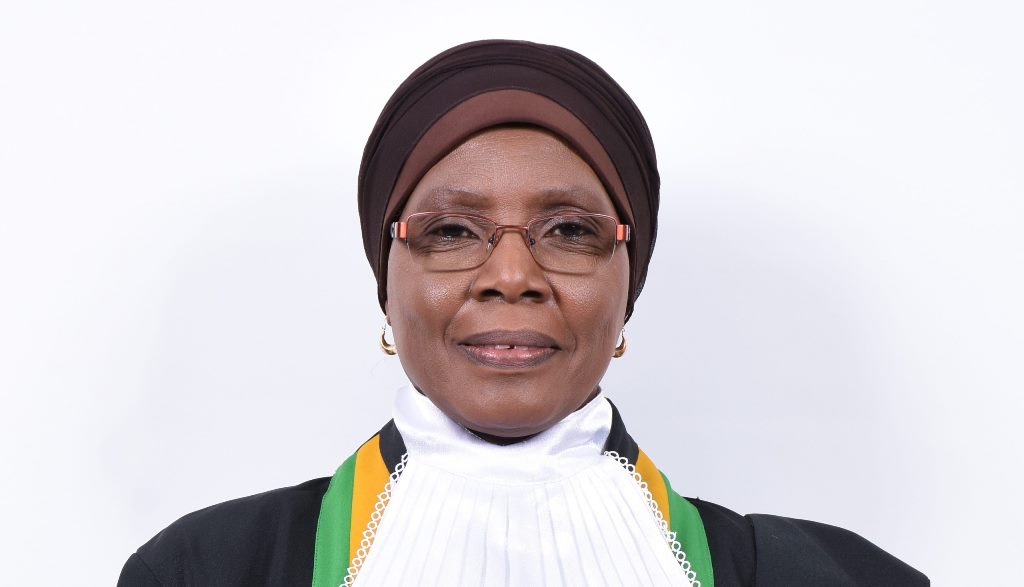
The African Court on Human and Peoples' Rights (AfCHPR) on Monday elected Lady Justice Imani Daud Aboud as its new President for a two-year term.
The Tanzanian Judge who replaces Sylvain Oré from Ivory Coast, becomes the second female judge to head the continental court after Ghanaian Sophia Abea Boafoa Akuffo, and a second from the country after the late Justice Augustino Ramadhani.
Lady Justice Aboud will now be deputised by Justice Blaise Tchikaya from the Republic of Congo (Brazzaville). According to Head of Media and Information Unit at the AfCHPR, Sukdhev Chatbar, Lady Justice Aboud was elected by a panel of 11 judges during the Court's 61st Ordinary Session, which started here.
The new AfCHPR President was first elected as Judge of the African Court on Human and Peoples' Rights in July 2018. She holds Master of Laws (Malta) and Bachelor of Laws (University of Dar es Salaam). Lady Justice Aboud was also a Judge of the High Court of Tanzania.
Before joining the AfCHPR, Lady Justice Aboud held several key positions, including the post of the Assistant Director in the President's Office (Public Service Management) and the State Attorney.
She represented the Government in various international human rights conferences, seminars and workshops and was also involved in making periodic reports on Human Rights to UN and other monitoring bodies such as the African Commission on Human and Peoples' Rights.
The Tanzanian also served as a Vice-Chairperson in the Independent Review Electoral Commission (IREC or Krigler Commission) in Kenya. The Commission was formed to facilitate the work of the Panel of Eminent Personalities under the leadership of the late Kofi Annan, Former UN Secretary General.
The Commission's responsibility was to review the 2007 election process in Kenya. Shortly after taking the oath of office, Lady Justice Aboud vowed to work closely with African countries in upholding justice on the continent. Meanwhile, yesterday' session saw the Arusha based court swear-in two Judges elected during the 34th African Union Heads of State and Government Ordinary Summit in February 2021.
Those who took oaths of office include Justice Dumisa Buhle Ntsebeza from South Africa and Malian Sacko Modibo. The newly elected Justices are replacing Ivorian Judge, Sylvain Oré and Justice Ângelo Vasco Matusse from Mozambique. According to information obtained from the Arusha based court two other judges were for a second and final term. They include Justice Rafaâ Ben Achour from Tunisia and Tanzania's Lady-Justice Imani Daud Aboud.
During the four-week session, the AfCHPR will examine a number of applications. The Session will also formally launch its 2021-2025 Strategic Plan today.
The Continental Court was established by virtue of Article 1 of the Protocol to the African Charter on Human and Peoples' Rights on the Establishment of an African Court on Human and Peoples' Rights, to complement the protective Mandate of the African Commission on Human and Peoples' Rights, with a view to enhancing the protection of human rights on the continent.
The Protocol was adopted on June 9, 1998 in Burkina Faso and came into force on January 25, 2004. The Court officially started its operations in November 2006 initially in Addis Ababa and a year later moved to its permanent seat in Arusha, Tanzania.
AfCHPR Launches Strategic Plan
The newly elected President of the African Court on Human and Peoples' Rights (AfCHPR), Justice Imani Aboud, on June 2nd, 2021 launched the African Court's Strategic Plan for 2021-2025 and setting out indispensable steps to be taken to raise public trust.
The plan would also guide the court's own development over the next five years and lay out core values, which seek to improve functioning, increase impact and strengthen relationships with individuals and institutions that share the Court's purpose, especially ensuring respect for human rights on the continent.
Justice Aboud said at the launching ceremony in Arusha that greater confidence by African citizens, states and institutions in the African human rights system, would be achieved through a set of deliberate mechanisms and actions that build on the core principle in which, the Court has been founded.
She pointed out that they have envisaged a path for the African Court to work more closely with its various stakeholders, build on each other's capacity and learn from each other's experiences, and as well avoid the duplication of efforts and instead, reinforce each other's strengths.
"This will involve closer engagement with national human rights stakeholders, such as national courts, governments, parliaments, national human rights institutions, NGOs including those operating at the regional and continental level, bar associations, academia and the media," the Court's President said.
Justice Aboud said it would also entail closer engagement with African Governance Architecture Platform Members, most notably the African Commission on Human and Peoples' Rights, the African Committee of Experts on the Rights and Welfare of the Child and Regional Economic Community Courts.
The President further explained that they were also determined to enhance their collaboration with international partners such as the United Nations human rights bodies and Inter-American human rights courts and institutions.
"We anticipate the concrete and practical forms of engagement outlined in this Strategic Plan will translate the abstract ideas of cooperation and synergy into real shifts of thinking and acting in daily lives of judges, staff and partners in fulfilling common goal of protecting human rights," she said.
The Tanzanian who has just been elected President of the continental court, said in pursuit of shared objectives, the African Court would remain open but also actively seek out new ways to strengthen the complementary nature of its human rights protection mandate.
"It is expected that in five years' time, this will result in an African Court that can present tangible evidence of increased efficiency and effectiveness that will lead to greater credibility in the capacity of the human rights system, to make a positive difference in the lives of people," she said.
In his key words to the session, the Registrar of the Court, Dr. Robert Eno said that they have learnt that improved judicial processes have little meaning, if they do not adequately cater to the needs of the Court's core constituents, individuals and people whose rights have been violated.
To that effect, he said, the African Court would over the course of the next five years not only ensure that it has the internal capacity to best serve those in need, but it would also ensure that it creates the optimal conditions for accessibility and high-quality judicial service delivery.
"In guaranteeing the necessary institutional capacity, the African Court will build on its tried and tested practices and strategies to foster a conducive work environment for its Judges and staff, founded on the values of respect, integrity and professionalism," the Registrar said.
He pointed out further that in ensuring accessibility and top-quality service delivery to its stakeholders, the African Court would continue to undertake its operations based on the principles of transparency, ownership and accountability.