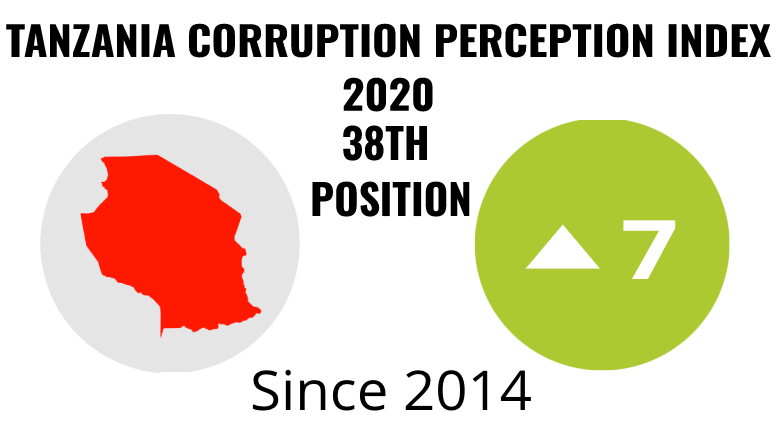
Tanzania has climbed seven places to secure the 94th position in the 2020 Corruption Perceptions Index (CPI) released last week.
The East African nation amassed 38 points, out of a possible 100, making it the second least corrupt country in the region having posted a significant improvement in the findings which ranks 180 countries on a scale from 100 (very clean) to 0 (highly corrupt).
Rwanda comes first in the index released by Berlin-based Transparency International (TI) having collected a total of 54 points ranking number 49 globally.
Kenya garnered 31 points to become the region's third least corrupt nation where it is at position 124 out of the 180 countries.
Following closely is Uganda which bagged 27 points, securing the 142th slot while both Burundi and South Sudan tailed the region with 19 and 12 points respectively.
Tanzania's success in the global index doesn't come as a surprise if President John Magufuli's zeal of slaying the corruption dragon is anything to go by.
Time and time again, the no-nonsensical charismatic leader has reminded public servants on how strict he is in taming the vice. Such zeal has seen him earn himself credibility and acclaim, both in and outside Tanzania.
"I'm telling Government Officers who are lazy and negligent to be prepared. They were tolerated for a long time. This is the end," warned President Magufuli in his maiden speech six years ago.
He has maintained his stance on corruption and never hesitated to sack corrupt and non-performing public servants throughout his presidency.
A glance at the index revealed Denmark, New Zealand and Finland as countries with the lowest perceived corruption levels - with South Sudan, Somalia and Syria being at the other end of the spectrum.
The 26th Edition of the Index paints a grim picture of the state of corruption worldwide.
According to TI, while most countries have made little to no progress in tackling corruption in almost a decade, more than two-thirds of countries score below 50.
"Our research shows corruption not only undermines the global health response to COVID-19, but also contributes to a continuing crisis of Democracy," reads part of the Index.
TI Chairperson, Delia Matilde Ferreira Rubio noted in the findings saying COVID-19 was not just a health and economic crisis, but a corruption crisis that most countries in the world were failing to manage. In its recommendations, TI has called for strengthened oversight institutions.
"To ensure resources reach those most in need and are not subject to theft by the corrupt, anti-corruption authorities and oversight institutions must have sufficient funds, resources, and independence to perform their duties," it said.
It is also rooted for the publishing of relevant data saying publication of disaggregated data on spending and distribution of resources is particularly relevant in emergency situations, to ensure fair and equitable policy responses.