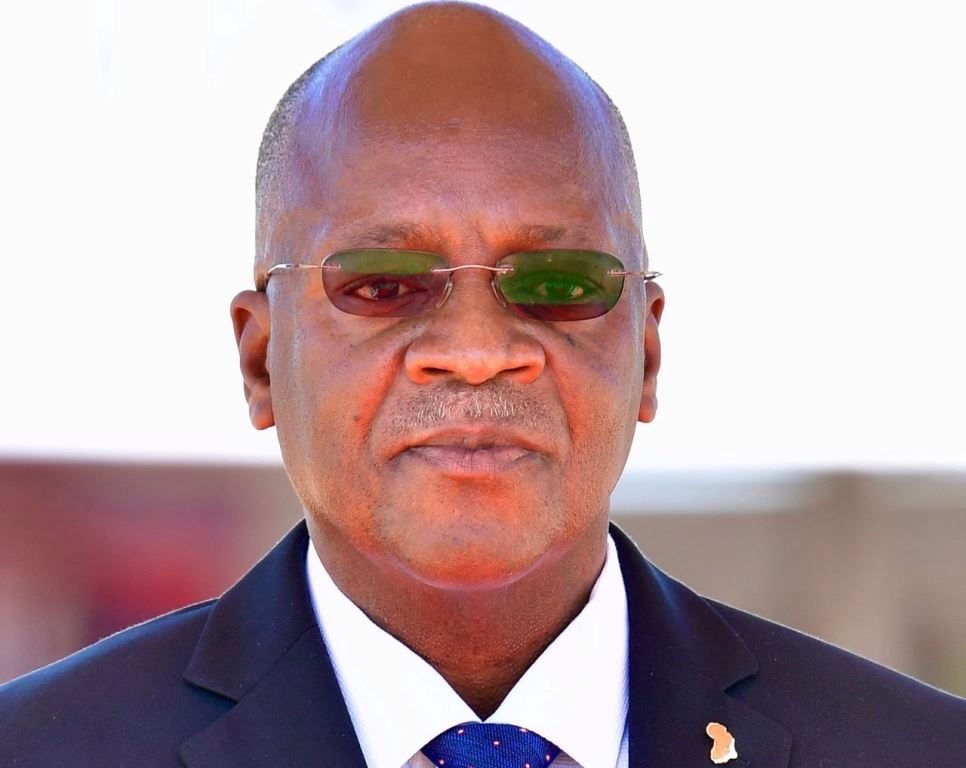
The fallen iconic Tanzanian President, John Pombe Joseph Magufuli has written his own history on the country's land, leaving behind landmarks of remarkable projects in just five years plus of his presidency.
Travelling by bus to any region, one can hardly miss seeing socio-economic structures that have been set up during the leadership of Magufuli.
Ranging from roads, railway, water, schools, hospitals, airplanes and so on that were intended to boost social-economic development and alleviating Tanzanians from prolonged poverty.
His Government made great strides in construction of road networks, not only highways but also feeder roads and street roads which have completely given new life to cities and streets.
As the Nation is engulfed in total grief over losing its great leader, those socio-economic structures serve as his legacy he left to Tanzanians.
More economic opportunities opened up and traffic congestion eased following construction of tarmac roads, bridges and flyovers countrywide.
In total, during the past five years plus his Government has accomplished construction of a new tarmac road network of over 3,500 kilometres, making the country to have a total of about 13,000 kilometres network of tarmac roads.
The most notable symbols of his life in the Nation's top post includes the construction of Mfugale Flyover in Dar es Salaam, initially known as the Tazara Flyover.
Tanzania National Roads Agency (TANROADS) and Sumitomo Mitsui Construction Co. Ltd. (SMCC) signed a contract on 15th October, 2015 concerning the project for improvement of Tazara Intersection which marked the construction of the first flyover in Tanzania under the framework of the grant aid project supported by the Japan International Cooperation Agency (JICA).
Currently operating, the bridge came to relieve traffic congestion in the city, facilitating speed movement of cars to and from the city centre.
Several studies confirmed that the traffic congestion had cost the city dearly, with billions of money lost in traffic jams, thus affecting the economy.
Construction of the flyover commenced in October 2016 at an estimated cost of US $965.9m.
Traffic congestion in Dar es Salaam was recognized as a severe problem in Tanzania. According to estimates of the National Bureau of Statistics, a total of 411.55bn/- was lost in the year 2013 due to this congestion.
"For the first time in our country's history we have managed to construct flyovers and interchanges in Dar es Salaam city in order to ease congestion," Dr. Magufuli stated when he dissolved the 11th Parliament, last year.
The construction of the Ubungo interchange was the second flyover project to be undertaken in the country.
Commenced in March 2017 during his first term in office, he inaugurated it last month in a short ceremony and named it after the former Chief Secretary John Kijazi who died on February 17.
The interchange which has two levels was constructed in Ubungo District at the intersections of the Morogoro, Sam Nujoma and Nelson Mandela roads.
The lower section of the interchange is 5 kilometres long whereas the middle section on Morogoro road is 260 metres long standing at 8.9 metres high.
During his leadership, Magufuli made hard decision, where for the first time in over 50 years, he took the initiative to construct a new railway line, the Standard Gauge Railway (SGR) from Dar es Salaam to Morogoro, and from Morogoro to Dodoma.
The modernization is a valuable contribution to Tanzania's future development to meet an increasing demand for transportation of passengers and improve the domestic supply network.
The railway line is intended to ease the transfer of goods between the port of Dar es Salaam and the cities of Kigali, in Rwanda and subsequently to Bujumbura, in Burundi, and to Goma, in the Democratic Republic of Congo.
From the lake port of Mwanza, surface water ferries are expected to transport goods between Mwanza and Port Bell and Bukasa Inland Port, in Kampala, Uganda’s capital city.
The SGR system in Tanzania, in conformity with neighbouring Rwanda and Uganda is designed to use electricity to power its locomotives.
The SGR is expected to accommodate passenger trains travelling at 160 kilometres (99 mi) per hour and cargo trains travelling at 120 kilometres (75 mi) per hour.
When laying the foundation stone for the SGR construction, the late President Magufuli said the SGR would speed up the country’s industrialization drive.
The SGR will run parallel with the existing German-built central railway line, and will allow a speed of 160 km per hour and will handle about 17 million tonnes per annum.
Dr. Magufuli was tough when he wanted to see his Government's plans materialize, as he did for the Julius Nyerere Hydropower Project (JNHP) which its implementation welcomed several criticisms from environmentalists.
The ongoing construction of the JNHP, also known as the Rufiji Hydropower project, the 2,115 megawatts dam will be the largest by installed capacity in East Africa and among the largest in Africa comparable to Egypt's Aswan High Dam (2100 megawatts) Mozambique's Cahora Bassa Dam (2075 megawatts) and Angola's Lauca Dam (2069 megawatts).
The 2115 MW Julius Nyerere Hydropower project is expected to transform the country through generation and supply of reliable electricity for both domestic and industrial use.
"The investment and generation costs for the Rufiji project are cheaper than any other alternative source of electricity. Our manufacturing factories cannot be competitive if the cost of electricity remains high," the late Dr. Magufuli said when he inaugurated the project in July, 2019.
Magufuli said the 2,115-megawatt Rufiji power project would more than double the East African country's current power generation capacity of around 1,600 megawatts.
"This project is expected to be completed in June 2022. Make sure you accomplish this project on time or before time," he told the Egyptian contractors.
His memory will continue to linger among Tanzanians over efforts he made to revive the national airline, Air Tanzania Company Limited.
In a few years the company regained its lost glory, with JPM's government purchasing new commercial airplanes. Over 400 jobs have been created upon the reformation of the company.
The eight brand new planes also generate revenue, whereby the monthly revenues of ATCL has gone up from 2.5bn/- to 15bn/-.
He also laid the foundation stone for construction of a bridge over a section of Lake Victoria between Kigongo and Busisi.
The construction of the 3.2-kilometre bridge, which is financed by the Government at a cost of 699bn/- is being undertaken by China Civil Engineering Construction Group (CCECG) and China Railway 15th Bureau.
The longest in East Africa and the sixth longest in Africa, it is scheduled to be completed in July 2023 and will involve construction of a 34-kilometre road to Mwanza.
The state-of- the- art bridge is expected to replace ferry services between Kigongo and Busisi, cutting down travelling time across the channel from approximately three hours to four minutes and allowing an increase in the number of vehicles crossing daily from 1,600 to 10,200.
President Magufuli highlighted the huge positive impact the bridge will have on the nation’s economy, saying it would enhance movement of people and goods, curb marine accidents while promoting trade and other economic activities in the lake zone and beyond.
"Construction of the bridge using Tanzanian taxpayers' money is further proof that our country is not poor and that if we dare we can do," said Dr. Magufuli who went on to encourage Tanzanians to be proud of their country's successes, noting that the bridge should expedite trade between Tanzania and her neighbours.
In the mining sector, the construction of the 25-kilometre wall surrounding the Mirerani Tanzanite mine is a historic mark.
The visionary Magufuli ordered the building of the wall to curb smuggling and make sure Tanzania and Tanzanians benefit from the business.
He had noted that for many years several other countries were ranked high in exporting Tanzanite compared to Tanzania where the precious gemstone is found.
"Tanzanite is found only in Tanzania but we were not in the list of main exporters of the most expensive stones," he said.
"Today, we have Tanzanian billionaires like Saniniu Laizer, it is because we decided to build the wall and set good policies and laws that allow small scale miners to fully engage in mining and mineral businesses," he said.
In January this year, Dr. Magufuli wrote another history by inaugurating the 617-billion water project at Ali Hassan Mwinyi stadium in Tabora.
The project consisting of 281-kilometre length pipe taping water from Lake Victoria, was a continuation of his government's efforts to supply water from the lake to places with high demand of the precious liquid.
The mega 617-billion-water project will benefit residents of Tabora, Nzega and Igunga districts.