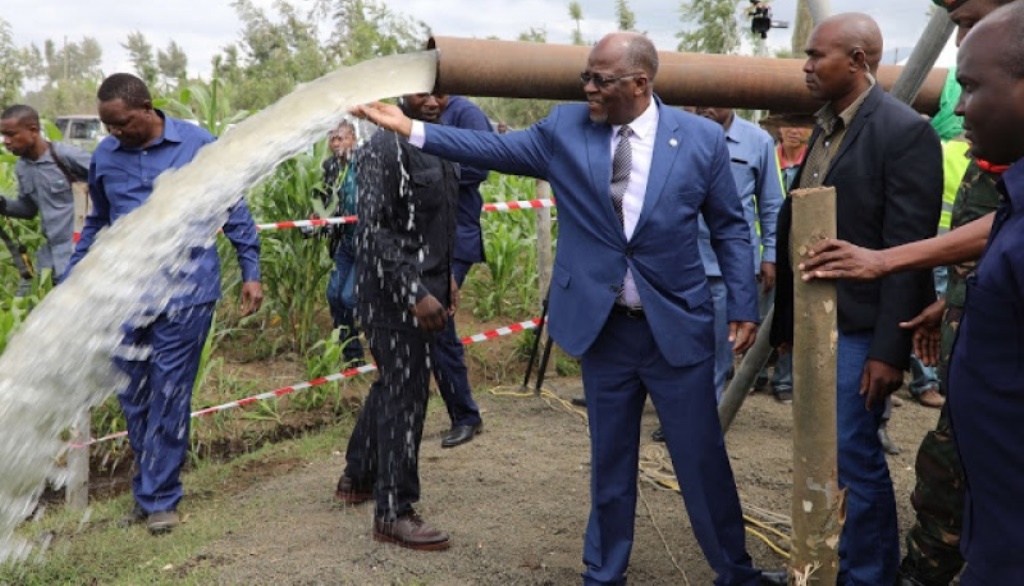
Tanzania has recorded tremendous achievements in both education and water sectors during the past five years of President John Magufuli, as the country looks to be among top performers on the implementation of Sustainable Development Goals (SDGs).
Quality education and clean water and sanitation are in SDGs number four and six respectively and Tanzania is on the right path towards achieving both targets.
While President Magufuli is only four months into his second presidential term, but assessments of the President's first term show that the results in both Education and Water sectors are superb, according to the Chief Government Spokesperson, Dr. Hassan Abbasi.
Addressing reporters in Dodoma on Monday, Dr. Abbasi said a lot of funds had been heavily injected in both sectors, yielding positive results to Wananchi.
In the Education sector for example, parents and children are currently benefiting from the positive results in the sector including free basic education, investment in schools, infrastructure and human resources as well as provision of students loans in higher learning institutions, among others.
"In free basic education, as of February 2021, the Government had spent about 1.291 tri/-, which have increased school enrollment in primary school from 1,386,5 92 in 2015 to about 1,57,453 in 2020," he said.
Dr. Abbasi who doubles as Permanent Secretary in the Ministry of Information, Culture, Arts and Sports said with free basic education, the number of pupils who have so far received primary education has increased from 8,298,282 in 2015 to about 10,925,896 in 2020.
Other achievements include an increase in the number of students in secondary schools from 1,648,359 in 2015 to about 2,185,037 in 2020, while the number of students joining Advanced Level Education increased from 66,090 in 2015 to about 74,478 in 2020.
"Pass rates for students in Form Four final examinations also increased from 68 percent (2015) to 85.8 percent in 2020, while in form six examinations the percentage rate increased from 97.94 (2015) to 99.51 percent in 2020," he further revealed.
In the past five years, Dr. Abbasi said the Government increased loans to students of higher learning institutions from 125,126 in 2015 to 142,179 as of February 2021 and that for the past five years; the Higher Education Students Loans Board (HESLB) spent a total of 2.82 tri/- in students' loans.
The Government also employed 26,181 primary and secondary school teachers, as well as 397 laboratory technicians where as 1,696 modern laboratories were constructed during the past five years.
Other infrastructures include construction of new classrooms (17,215) , teachers houses (1,780) , rebuilding of 89-old schools including rebuilding the new Ihungo Secondary school in Kagera Region, which was destroyed by a tremor that hit the region a few years back.
Dr. Abbasi further took time to outline the achievements in water services across the country.
Statistics show that implementation of water projects has increased access to water from 47 percent in rural areas and 74 percent (Urban areas) in 2012 to about 72.3 percent and 86 percent respectively as of February 2021.
The fifth phase Government's target is that come 2025 water services in urban areas should reach 95 percent, while in rural areas it is projected at 85 percent.
To breach the remaining gap 13 percent in rural areas and 9 percent in the urban, Dr. Abbasi said the Government is currently implementing several water projects that will help in meeting the target, empowering water regional water bodies as well as instituting appropriate legal actions against negligent officials who are delaying the implementation of the projects.
"As of February 2021, the Government implemented 1,845 water projects valued at 1.916 tri/- which helped about 14,726,600 people to have access to water services. "Out of those projects, 222 were implemented in urban areas while 1,626 were carried out in rural areas," he noted adding that the work was still on as 924 other projects valued at 2.2 tri/- were being implemented countrywide, out of which 110 were in urban areas while 814 others were being implemented in rural areas.
Upon completion, the Government Chief Spokesperson said, about 12,07,450 people will have access to clean and safe water. He added that with the new measures, revenue collection from different water authorities increased from an average of 176.87 bn/ - per year in five years ago to an average of 301 bn/- each year.