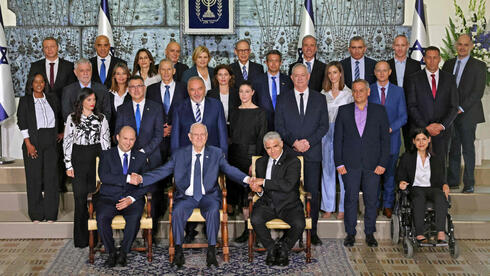
At 11.00am, all 27 members of the new Cabinet gathered with Prime Minister Naftali Bennett at President Reuven Rivlin's official Residence in Jerusalem for the traditional official photograph.
Finance Minister Avigdor Liberman, Defense Minister Benny Gantz, Foreign Minister Yair Lapid and Prime Minister Naftali Bennett meeting Sunday night for the first time after the new government was sworn in
(Photo: AP)
Who's who in Israel's new patchwork coalition government
Members of the 36th government of Israel
Israel's new Government, sworn in on Sunday, consists of a hodgepodge of political parties that have little in common. The coalition spans the far-left to the far-right and includes for the first time a small Islamist faction representing Israel's Arab minority. It is expected to focus mostly on economic and social issues.
Here are the people who will be leading the new Government:
Naftali Bennett — Prime Minister
Prime Minister Naftali Bennett addressing Knesset on Sunday (Photo: AP)
Bennett leads the ultranationalist Yamina (Rightwards) party that champions Jewish settlement in the occupied West Bank. He made a fortune in Israeli high-tech before entering politics in 2013. He served in previous Netanyahu-led governments, most recently as Defense Minister. Under the coalition deal, Bennett will serve as prime minister for two years and until he is replaced by Yair Lapid. He will be the country's first leader to wear a kippah, a skullcap worn by Orthodox Jews.
Yair Lapid — Foreign Minister
Foreign Minister Yair Lapid (Photo: Alex Kolomoisky)
Lapid heads the centrist Yesh Atid (There is a Future) party and was the architect behind the new Government. His party is the biggest in the coalition but he agreed to share power with Bennett to secure a parliamentary majority. He quit his job as a TV anchor in 2012 and formed his own party, running on the promise to ease financial pressures on the middle-class. He also seeks to end many of the state-funded privileges enjoyed by ultra-Orthodox Jews, a long-running source of grievance to many secular Israelis. Lapid will serve as Foreign Minister for two years and then take over as Prime Minister until the end of the Government. If it lasts that long.
Benny Gantz — Defense Minister
Defense Minister Benny Gantz (Photo: EPA)
Just two years ago Gantz, a former Military Chief heading the centrist Blue & White party, was the opposition's best hope to unseat Netanyahu. But he agreed to join Netanyahu in a "unity" government, a decision that angered many of his supporters. He will be a part of the new coalition, remaining in the post of Defense Minister.
Avigdor Liberman — Finance Minister
Finance Minister Avigdor Liberman (Photo: Israel Bar Association)
As Finance Minister, he will have to rein in a budget deficit that ballooned during the cCoronavirus crisis. He has also said he will try to change the status quo between the Government and Israel's politically powerful ultra-Orthodox minority, which is a mainstay of Netanyahu's outgoing government. The ultra-Orthodox community has low participation rates in the workforce and relies heavily on Government handouts while focusing on religious studies. Lieberman has said he will work to integrate them more into the economy.
Gideon Saar — Justice Minister
Justice Minister Gideon Saar (Photo: Amit Shabi)
Saar was Netanyahu's main rival within Likud, but Netanyahu did his best to keep him out of the spotlight and away from the highest-level portfolios. Frustrated, Saar launched a failed leadership bid then spun off his own party. As Head of the New Hope party, Saar will be bumped up to Justice Minister, where he will oversee the legal system and become a Member of the Security Cabinet.
Merav Michaeli — Transportation Minister
Transporation Minister Merav Michaeli (Photo: Amit Shabi)
Like Lapid, Merav Michaeli started in the media world, spending her mandatory military service at Army Radio, where she later became one of the founders of its sister station Galgalatz, later moving to TV. After joining Labor, Michaeli was first elected to Knesset in 2013, serving in several roles, including as chair of the Foreign Affairs and Defense Committee. In 2020, she moved to the opposition after her fellow party members Amir Peretz and Itzik Shmuli decided to join Gantz in his unity government with Netanyahu. Ahead of the March 2021 election, Michaeli won the leadership of Labor — which gained 7 seats in the polls after it barely made the cut in the prior vote.
Nitzan Horowitz — Health Minister
Health Minister Nitzan Horowitz (Photo: Moti Kimchi)
Before entering politics, Nitzan Horowitz worked as a reporter for a number of Israeli media outlets, among them Army Radio, Haaretz and the now-defunct Channel 10. He was first elected to Knesset in 2009 as a member of the left-wing Meretz party. In 2013, he ran against Ron Huldai for the office of Mayor of Tel Aviv and lost. In September 2019, Horowitz returned to Knesset after winning the leadership of the party from Tamar Zandberg.
Mansour Abbas
Ra'am leader Mansour Abbas (Photo: Tal Shahar)
Abbas's small United Arab List will be the first party in an Israeli government to be drawn from Israel's 21% Arab minority. He split with other Arab politicians who prefer to remain outside government and cast aside differences with Bennett and other right-wingers to tip the scales against Netanyahu. Abbas is expected to serve as a Deputy Minister in the Prime Minister's Office. He aims to negotiate a big increase in government spending in Arab towns and villages.
But his presence is a potentially destabilizing factor. He has been criticized by Palestinians for agreeing to support an Israeli Government while Israel continues to occupy the Palestinian territories. Addressing these tensions, Abbas told the Italian daily "La Repubblica" on Friday: "There will be difficult decisions to be made, including security decisions. We have to juggle our identity as Palestinian Arabs and citizens of the State of Israel, between civil and nationalistic aspects."