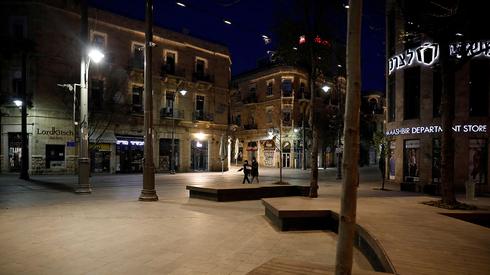
The government on Wednesday announced a raft of new restrictions that came into effect from 17.00 for a seven-day period, including a prohibition on people venturing more than 100 meters from their homes, apart from under certain circumstances, and the shuttering of synagogues.
An empty street in Tel Aviv (Photo: Shmulik Davidpour)
The regulations permit Israelis to leave their homes only for the following activities:
1. Going to work and coming back, within previously specified regulations on who is allowed to work;
2. Stocking up on food, medicine and necessary goods and to receive essential services;
3. Receiving medical care;
4. Donating blood;
5. For legal proceedings;
6. To attend a demonstration;
7. Going to the Knesset;
8. Receiving care in a social work framework;
9. A short walk of no more than 100 meters from one’s home either as an individual or with others from the same residence for an undefined “short period of time”;
Bnei Brak devoid of people
10. Helping a person with a medical problem or other difficulty that requires support, such as old age or physical infirmity;
11. Going to an outdoor area for prayer, a wedding, funeral or circumcision with fewer than 10 people at a distance of two meters apart. A woman can go to immerse in a mikveh provided that she has coordinated her arrival in advance;
12. Taking children to educational frameworks for those whose parents are essential workers (in accordance with previous orders);
13. Taking children whose parents do not live together from one residence to another;
14. Transferring a child whose sole caregiver is required to leave for an essential purpose.
The streets of Haifa
In addition, public transportation was reduced to around 25 percent of services and taxis will only be permitted to take one passenger unless the second is an escort for medical reasons. All passengers must sit in the back seat of the vehicle with the windows open.
All workers should maintain a distance of two meters, or six feet, from anyone else as much as possible.
In addition, all business owners are required to check the body temperature of anyone entering their businesses. Anyone with a fever exceeding 38 degrees Celsius (100.4 degrees Fahrenheit) is to be denied entry.
Restaurant delivery services are allowed to continue; however, takeout is no longer permitted. Shipping and delivery of items bought online can also continue but all packages are to be left outside the door of the residence.
Non-essential stores are to close and parks are to remain shut.
Essential home maintenance services are also permitted to continue.
People over the age of 60 are deemed to be an at-risk section of the population, and are encouraged to remain at home, according to the joint announcement from the Prime Minister’s Office and the Health Ministry.
Any store remaining open must ensure there is two meters between all staff and customers, and can only have four customers per active cash register.
Anyone found in violation of the regulations will be committing a criminal offense and can be fined NIS 500 ($137) or imprisoned for six months. The regulations allow police to enforce the relevant provisions.
An Israeli who operates public transportation in violation of the ordinances can be fined NIS 5,000 ($1,370) or be imprisoned for six months.