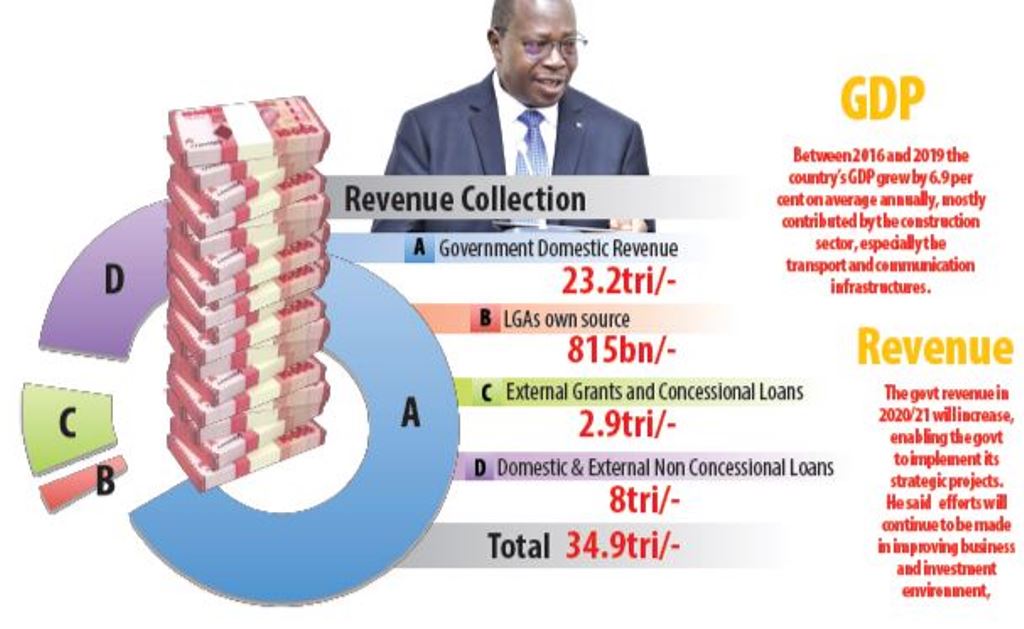
The government plans to spend 34.88tri/- in the 2020/21 financial year, which is expected to be financed by domestic revenue sources by 79.6 per cent.
The new budget framework shows a 1.77tri/- increase from the current 33.1tri/- budget, with recurrent and development budgets rising by 1,08tri/- and 0.7tri/- respectively.
Presenting the 2020/21 budget framework to Members of Parliament in Dodoma yesterday, the Minister for Finance and Planning, Dr. Phillip Mpango said the proposed budget aims at speeding up national economic growth by linking it with the growth of individuals' per capita incomes.
According to Dr. Mpango, the new budget framework has been prepared under the guidance of the second Five Year Development Plan, which comes to an end in the next fiscal year.
The Minister told MPs that out of 34.88tri/-, a total of 21.98tri/- is for recurrent expenditure while 12.9tri/-, equivalent to 37 per cent of the total budget, will finance development projects.
He said out of the 12.9tri/- development budget, a total of 10tri/-, an equivalent to 78.8 per cent will be internally sourced, while the remaining will be externally sourced.
Part of the development budget will also finance the general elections scheduled to take place later this year. However, the minister did not divulge the amount for the undertaking.
Expounding further on the sources of funds to finance the budget, Dr. Mpango said the government will domestically raise a total of 24.07 tri/-, which is equivalent to 69 per cent of the total budget, while borrowing domestically a total of 4.90tri/-.
The government will seek external concessional loans amounting to 3.04tri/-. Grants and non-concessional loans from development partners, according to the minister, will generate 2.87 tri/- which is equivalent to 8.2 per cent of the whole budget.
According to the breakdown, the Tanzania Revenue Authority (TRA) will be responsible for collecting 20.33 tri/- to finance the new budget while non-tax revenue will be 2.9 tri/-.
Local government authorities will be required to raise 814.96bn/-. The breakdown of the development budget shows an ongoing Nyerere Hydro Power project will receive 1.60 tri/- while the Standard Gauge Railway will get 2.10 tri/-.
In the same development budget, the government is expected to spend 400bn/- to settle its verified debts. On the part of recurrent expenditure, the government, among other things will use to settle verified debts, spend 7.76tri/- in paying civil servants' salaries and use 1.29tri/- in making contributions to the pension fund.
However, Dr. Mpango told MPs that the government revenue in 2020/21 will increase, enabling the government to implement its strategic projects.
He said efforts will continue to be made in improving business and investment environment, improving voluntary tax collection environment and widening tax base and working on various challenges, including tax evasion.
Speaking on the state of the economy between 2016/17 and 2020/21 Dr. Mpango said the government recorded tremendous achievements under President John Magufuli.
He said between 2016 and 2019 the country's GDP grew by 6.9 per cent on average annually, mostly contributed by the construction sector, especially the transport and communication infrastructures.
Other factors include improvement in water and information services, increase in mining activities and crop production.
The positive trend in GDP growth contributed to creation of 6,032,299 job opportunities out of which 1,975,723 opportunities were in the formal sector and 4,056,576 in the informal sector.
Speaking on inflation, Dr. Mpango said in the past four years the price rises maintained a single digit of 4.4 per cent.
However, he said between July last year and January this year inflation dropped to 3.7 per cent on average, the agreed ceiling among East African Community (EAC ) member states.
The Minister said inflation in 2019 remained low due to availability of foods, stability of fuel prices in the world market and good and efficient implementation of fiscal policies and the government budget.
Speaking on money supply, the Minister said the stock of money in the economy had improved considerably, explaining that in 2019 it had increased to 28.31tri/ from 25.82tri/- in 2018, which is equivalent to 9.6 per cent.
He said the increase in money supply was a proof of availability of sufficient stocks of cash to run the economy and ability of the banking sector to issue loans to the public for various economic activities.