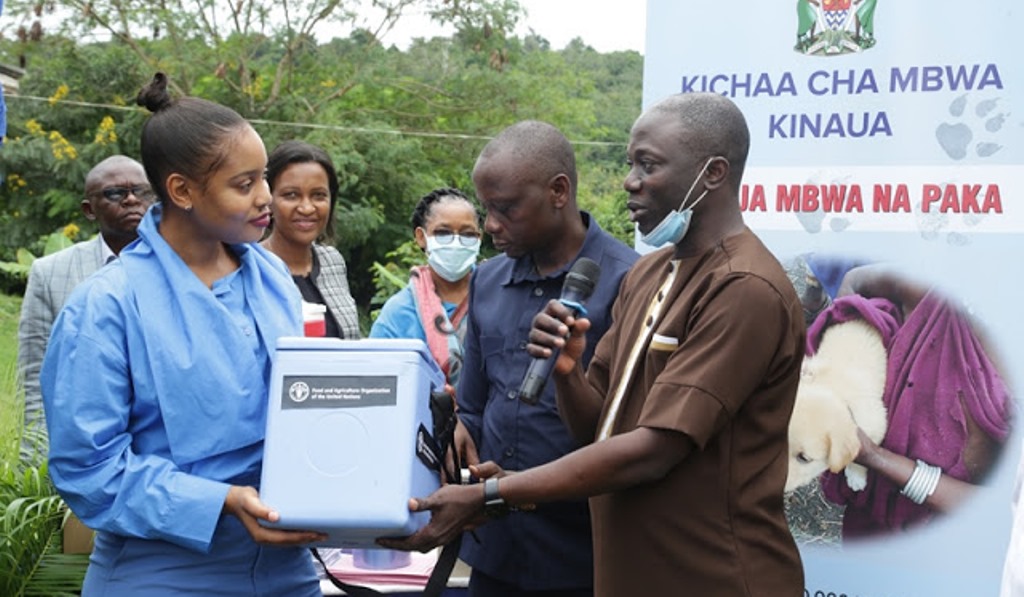
The Government has launched a National Canine Rabies Vaccination Campaign in Kisarawe District, Coast Region to fight the viral disease that kills about 1,500 people annually in the country.
Fifty students from Sokoine University of Agriculture and Muhimbili University of Health and Allied Sciences (MUHAS) would inoculate dogs and cats and provide education about rabies prevention in 17 wards of Kisarawe District considered to be among the hotspots for the disease.
At least 70 percent of all dogs and cats in the country that are estimated to reach 4.5 million and 2.0 million, respectively will be inoculated in the rabies vaccination drive launched by the District Commissioner, Jokate Mwegelo.
Ms. Mwegelo thanked development partners who supported the Vaccination Campaign and hailed the Ministry and Partners for initiating use of University students in the campaign to help them get the necessary field experience while making optimal use of available human resources.
She urged the local community in the district to come out in large numbers to get an education and bring their dogs and cats for vaccination. <
"Let us leaders go out to the people and encourage them to come out and participate in this campaign. No dog or cat should be left out," she said in the launching event.
She however called on district and ward leaders to get prepared to run other rabies vaccination campaigns that may follow using local resources instead of relying on donor support.
"Our leaders need to be prepared. In campaigns like this it is better to get prepared to be self-reliant. If we can organize ourselves we can take care of things like this campaign using our own money," she said.
The Director of Veterinary Services in the Ministry of Livestock and Fisheries Development, Prof. Herzon Nonga said the National Rabies Vaccination Campaign was under national rabies control strategy, and aims to eliminate rabies in the country by 2030.
He said under the campaign the Government aims at vaccinating at least 70 percent of all dogs and cats population estimated at 4.5 million and 2.0 million respectively.
Prof. Nonga said rabies was responsible for an estimated 1,500 deaths per year in Tanzania while dog attacks on humans (a proxy for rabies exposure) are estimated to reach 3,387 per year.
He said it was far easier to carry out canine rabies vaccination drive than treating people infected with rabies as it cost between 2,000/- and 3,000/- to inoculate one dog while it takes about 200,000/- to treat someone bitten by a suspected rabid dog or cat.
"Once clinical signs of rabies appear, the disease is nearly always fatal," he said, noting that vaccinating dogs or cats was the most cost-effective strategy for preventing rabies in people.
Prof. Nonga said under the national rabies control strategy vaccination of dogs was compulsory and owners of the animals would be needed make sure their dogs and cats are inoculated.
"Nowadays vaccinating your dog is no longer an option. It is compulsory and a legal issue," he said.
"The guideline is to keep dogs and cats that we can take care of instead of letting them wandering in streets. We have so many stray dogs and cats," he said.
Explaining why Kisarawe was chosen to launch the National Canine Vaccination drive, the Kisarawe District Livestock and Fisheries Development Officer, Dr. Emmanuel Kasian told the 'Daily News' that the district was among hotspots for rabies because of its proximity to the Nyerere National Park.
He said dogs and cats in the district were exposed to rabies from the wildlife from the National Park.
"Kisarawe is among the risky areas for rabies because it borders the Nyerere National Park and therefore there is wildlife, livestock and human interface," he said.
The Campaign is led by the Ministry of Livestock and Fisheries Development with support from Food and Agricultural Organisation (FAO), USAID, Africa One Health University Network (AFROHUN), SUA and MUHAS.