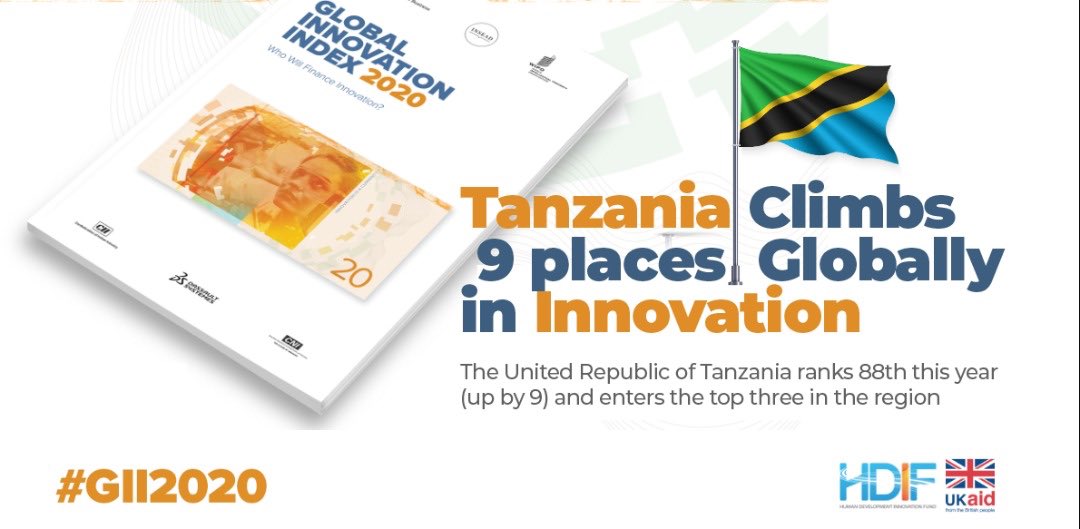
Tanzania has climbed nine places to the 88th in the Global Innovation Index (GII) ranking for this year, with the country performing above expectations for its level of development.
Tanzania, which ranked at 97th place in the previous GII report, has entered the list of the top three countries in Sub- Saharan Africa.
The new findings indicate that Tanzania has also performed well in ranking compared to its fellow East African Community (EAC) partner states, outsmarting all except Kenya.
Kenya is placed at 86th, Rwanda at 91st and Uganda at 114th. Burundi is not included in the GII rankings this year because of decreased data availability.
With the 2020 GII report based on the World Bank Income Group Classification of July 2019, when Tanzania was still a low income country, it ranks the East African nation as top performer in the group of low-income followed by Rwanda and Nepal.
Certainly, it is down to such splendid economic performance that Tanzania managed to change its economic status this year to middle income country, well ahead of schedule.
In July, this year, the World Bank (WB) announced Tanzania as a lower-middle income country. The GII is a ranking of world economies based on innovation capabilities.
Consisting of roughly 80 indicators, grouped into innovation inputs and outputs, the GII aims to capture the multi-dimensional facets of innovation.
The report says Tanzania has increased three positions in the Innovation Input sub-index (112th) and goes up six ranks in the Innovation Output Sub- Index (67th).
It has moved up the most in two pillars: market sophistication (87th), and Creative outputs (45th).
Overall, the country's relative strengths are evenly split between innovation inputs and outputs. It ranks in the top 25 in indicators cost of redundancy dismissal (25th) and gross capital formation (13th).
Others include tertiary enrolment (123rd), Global R&D companies (42nd), the quality of local universities (77th), GERD financed by business (102nd) and patent families (101st).
"It is worth noting that although Tanzania's data coverage is satisfactory, it could benefit greatly from updating its innovation metrics more systematically," the report says.
Some economists who spoke over the findings commended the country's achievement, saying the move was economically worthy.
Prof. Honest Ngowi of Mzumbe University commented: "This is a good sign that the country is doing well in having innovative ideas and products which are needed for the current knowledge or digital economy."
On his part, Dr. Hildebrand Shayo, an Economy and Investment Analyst, pointed out that Tanzania moving up to high positions in such rankings means that the country would earn more trust in International Financial Institutions when it needs to borrow money.
"This may also attract more Foreign Direct Investment (FDI) because more investors may come into the country upon seeing these improvements" he said.