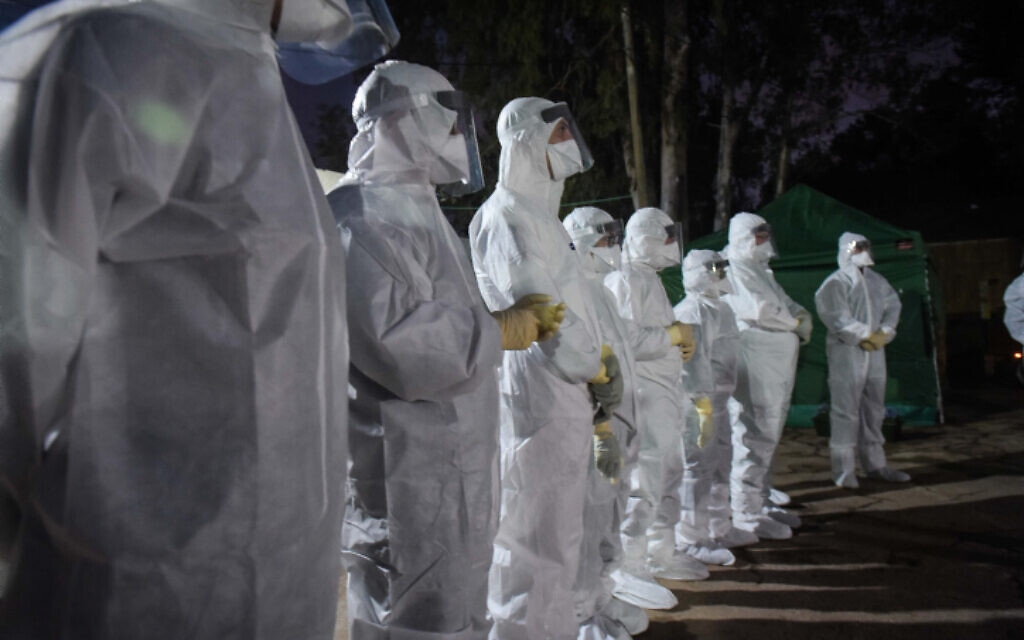
In response to the global outbreak of the new coronavirus, Israel has taken far-reaching measures to halt its spread in the country, including imposing a partial lockdown by instructing Israelis not to leave their homes unless absolutely necessary, closing all leisure venues, recommending work from home, barring non-nationals who are not based in Israel from entering the country and requiring people who may have been exposed to the virus to quarantine.
Public Security Minister Gilad Erdan has said a full lockdown is “inevitable.”
As of Sunday, March 22, the Health Ministry had confirmed 945 cases of COVID-19, the illness caused by the virus, in Israel. Some of the infected returned from countries with a high number of reported cases of the virus, while many others contracted it from exposure to carriers in Israel. There has been 1 fatality, and 20 are in serious condition.
On Thursday night the cabinet approved emergency regulations severely limiting freedom of movement for a period of seven days, and restricting citizens to their homes unless for purposes of work, stocking up or several other specified activities, while threatening punishment to rule breakers.
The government also authorized further workplace restrictions on Friday, limiting the public and private sector to just 30 percent of employees at a workplace at the same time. Industries considered vital to the economy and public well-being are exempted and businesses can continue operating if they abide by Health Ministry directives.
The country has banned gatherings of over 10 people, including for religious purposes, and has required those participating in any activity to maintain a distance of at least two meters (six feet) between one another.
The public has been ordered not to go out to parks, playgrounds, the beach, pools, libraries, museums or other public places. Exceptions are permissible for taking out children and pets — in accordance with instructions for maintaining hygiene and limiting social contact.
Among other measures are suspension of elective surgeries, cancellation of non-urgent dental treatments, and an instruction for deliveries to be left outside customers’ doors.
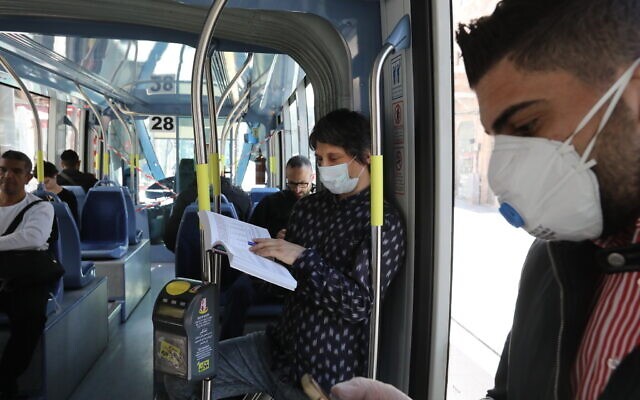
Illustrative: Israelis wearing face masks for fear of the coronavirus are seen in public transportation in Jerusalem on March 17, 2020. (Yossi Zamir/Flash90)
The Health Ministry has said Israelis should refrain from traveling in a car in groups larger than two and recommends that people refrain as much as possible from using public transportation.
All educational institutions are closed, regardless of the number of children per classroom, among them schools, kindergartens, daycare centers — including home daycares — special education, youth movements and after-school programs.
All workplaces with more than 10 employees have been ordered to trim in-house office staff by 70 percent. Those who must show up at work have been told to maintain a safe distance — two meters — from others.
Government offices are being largely curtailed, with up to 80 percent of staff being placed on leave.
Public transportation is continuing, though the Transportation Ministry announced it will cease at night and on weekends and that only lines that provide service to locations offering essential services will continue to operate. Riders can only board with a pre-paid Rav-Kav card as drivers will not take cash.
Save for supermarkets and pharmacies, all malls are closed. Restaurants and hotel dining rooms are also shuttered — aside from those that provide takeout — along with bars, pubs and dance clubs. All sporting events have been canceled.
Gyms, pools, water and amusement parks, zoos and petting zoos, bathhouses and ritual baths for men, beauty and massage salons, event and conference venues, public boats and cable cars, and heritage sites are also closed.
Authorities have also introduced limits on visits to hospitals and retirement homes, calling on public to refrain from visiting and adding that if someone needs a chaperone for a visit or appointment, they should make do with only one.
For those required to self-quarantine, the Health Ministry has issued instructions for how to do so. It has also issued guidelines for how to contact emergency health services for people who show symptoms of the virus.
How can people get tested for the virus?
Generally, only those showing COVID-19 symptoms and who returned recently from abroad or were exposed to a confirmed carrier are tested for the coronavirus.
Testing for the virus has increased from several hundred a day nationwide to some 2,200 on Wednesday, March 18. The Magen David Adom (MDA) emergency service has said it aims to begin collecting samples from 6,000 Israelis a day.
MDA has said it will offer 24-hour “drive through” COVID-19 testing in Tel Aviv and later also in Jerusalem, Haifa, Petah Tikva, Rishon Lezion and Beersheba.
Who needs to go into quarantine?
Israelis returning to the country from overseas are required to self-quarantine for 14 days from the time of their arrival.
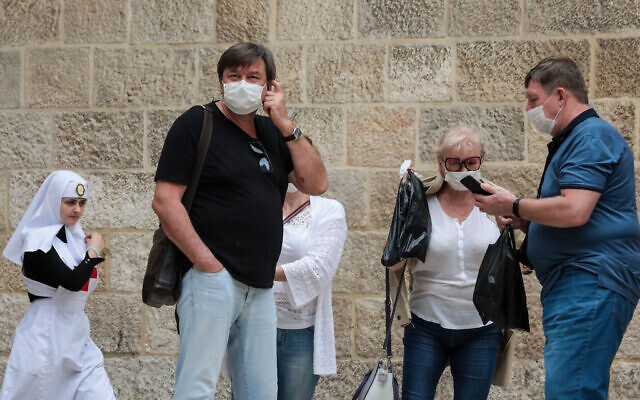
People with masks walk outside the Church of the Holy Sepulchre in Jerusalem’s Old City on March 12, 2020 (Yossi Zamir/Flash90)
Additionally, any person who was at the same location as a confirmed carrier of the coronavirus must self-quarantine in accordance with Health Ministry guidelines. A list of these locations and times can be found on the Health Ministry’s website.
People required to self-quarantine must report to the Health Ministry.
Are non-Israelis allowed into the country?
Effective Wednesday, March 18, non-Israeli nationals are barred from entering the country, even if they’re able to prove they can self-quarantine in accordance with Health Ministry instructions.
Non-nationals whose lives are based in Israel, as well as the spouses and children of Israeli citizens, will still be allowed into the country.
Those seeking to enter Israel must file a digital application with their local embassy or consulate, which will evaluate the request.

A screen displaying arrivals shows canceled incoming flights at Ben Gurion International Airport near Tel Aviv, on March 10, 2020. (Jack Guez/AFP)
What are the symptoms of COVID-19 and what does one do if they suspect they have it?
The symptoms of COVID-19 are a fever of over 38 degrees Celsius (100.4° Fahrenheit), coughing, difficulty in breathing, or any other respiratory symptoms.
Instructions on what to do if you believe you may have the virus can be found here. Anyone with a suspected case should not go to the hospital but instead report by phone to emergency health services.

Illustrative: An ambulance, carrying an Israeli woman returning from Italy who displayed symptoms of the coronavirus, arrives at the infectious disease unit at the Sheba Medical Center in Tel Hashomer on February 28, 2020. (Jack Guez/AFP)
Can Israelis travel overseas?
The Health Ministry on February 26 advised all Israelis to avoid traveling overseas, making Israel the first country to urge its citizens to refrain from traveling abroad entirely due to the coronavirus outbreak.
Healthcare workers have been barred from leaving the country and state employees have been advised by the Civil Service Commission not to travel overseas in an official capacity.
The Israel Defense Forces has banned soldiers from traveling abroad and canceled international exercises. Combat soldiers have been told to prepare for a month-long stay in their bases.
When is a cure for the virus expected?
Most experts around the world have estimated that the process of developing, approving, manufacturing and distributing a working vaccine for the coronavirus will take roughly a year, if not longer.
The director-general of the Health Ministry, who has led the fight against the spread of the coronavirus, said he believed this one-year estimate to be correct.
“My working assumption is that this cannot happen in the coming year,” said Moshe Bar Siman-Tov.
There have been several sporadic reports of various anti-viral drugs proving effective in treating the illness, though non have been confirmed as of yet.