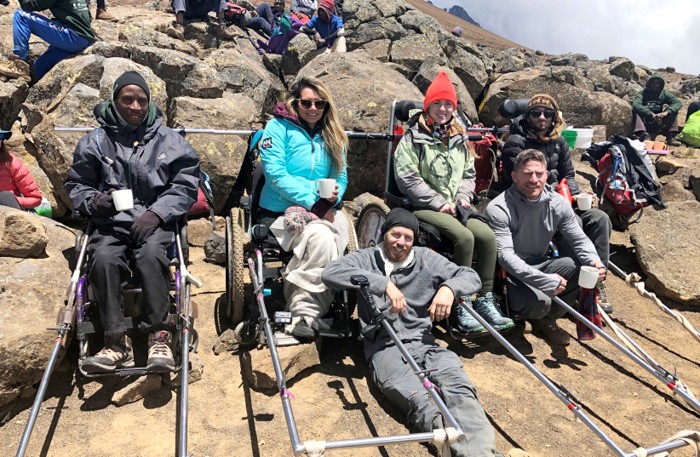
Arnold John, a Tanzanian from Moshi, father of three and living at the base of Kilimanjaro had always dreamed of making it to the top.
Part of a group of 27 hikers with different abilities, he recently climbed the 19,341-foot mountain to benefit Friends of Access Israel (FAISR), an Organization promoting accessibility, inclusion and respect for people of all abilities around the world.
FAISR’s collaborative partner, Access Israel, was founded just over 20 years ago in Israel and hosts an international conference each year in Israel, hosts “Dinners of the Senses,” and consults on accessibility and inclusion worldwide.
The FAISR Kilimanjaro 2020 Team included hikers from the United States, as well as participants from Israel and of course, Tanzania.
Other hikers with physical disabilities who participated on the strenuous, multi-day, heavily supported climb included Starla Hilliard-Barnes, Marcella Maranon and Arnon Amit.
It was required a wide range of gear, including hiking boots, poles and appropriate clothing to assure comfort as the group passed through five ecosystems.
The Israeli Delegation, consisting of Arnon, Omer Zur and Rowee Benbenishty were charged with boxing, transporting and assembling five Paratreks (“Trekkers”) - specially designed chairs that, with the help of Tanzanian porters, would help get the participants with disabilities up the mountain.
Zur is the inventor and CEO of Paratrek, a large-tire wheelchair-like device that relies on the abilities of both the rider and a team of up to six who pull, push and steer to make it possible for people with disabilities to join peers in such treks. Zur designed the initial Paratrek for his own father, paralysed when he was thrown from a tank in the Sinai Desert during the Yom Kippur War.
The delegation assembled at Moshi at the base of the mountain where the group met Sabino (“Sabi”) Kweka, a former porter and guide, who is now owner of the Popote Africa Adventures and the trip architect and coordinator. “Climbing a mountain is more about the mind. If you take it easy and relax, all goes easy,” Sabi noted.
The group would follow the Marangu route, also known as the Coca Cola trail, would stay overnight at the Mandara Hut (2,700 meters), Horombo Hut 3,700 meters), and spend Shabbat at the Kibo Hut (4,700 meters). Following a restful Shabbat on the mountain, the group would attempt the all-night climb to the 5,895-meter Uhuru Peak.
Each year, approximately 35,000 people attempt to climb Kilimanjaro. They use the six official Kilimanjaro routes. According to success rate figures published by the Kilimanjaro National Park, there is a 45% success rate for reaching the summit with chances of success rising to 85% if done over an eight-day period.
As the group set out from the Marangu Gate on February 4, Arnold John, the Tanzanian climber, was surrounded by Tanzanian media interviewing him for TV and newspapers; they wanted to hear the story of the local man who grew up at the base of the mountain, now having his first opportunity - with the support of the Israeli-designed Paratrek - to climb the mountain.
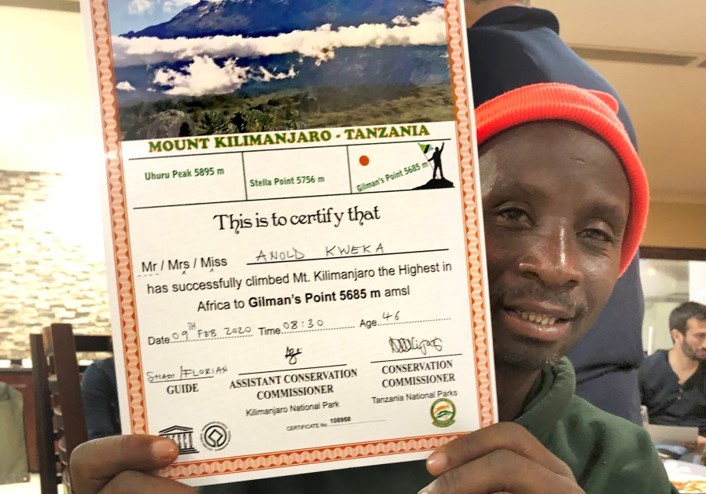
The group pulled together throughout. Even during moments of frustration and low morale, group members encouraged and inspired each other.
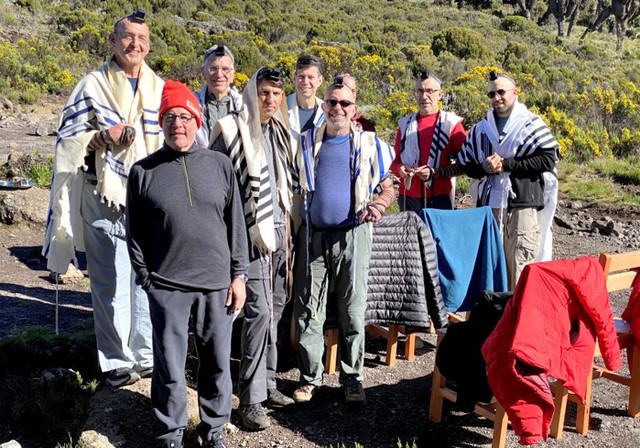
After four days of hiking, the group celebrated Shabbat together at the 4,700-meter Kibo hut. Dr. Barry Stein of Manhattan led Kabbalat Shabbat prayers.
Dr. David Muller of Teaneck, New Jersey, Dean for Medical Education at the Mount Sinai School of Medicine in New York, observed that the participants - fully dependent on their Tanzanian porters, guides and cooks for food and water – experienced a small taste of what it must be like for the fellow trekkers with disabilities who daily rely on others for various aspects of care and support.
Starting the all-night climb to the summit, the group trekked in the dark, through elevated deserts and snowy terrain for approximately nine hours and, thankfully, each participant - with and without disabilities - reached one of the three summits: Stella’s Point (5,756 meters), Gilman’s Point (5,685 meters), or Uhuru Peak (5,995 meters).
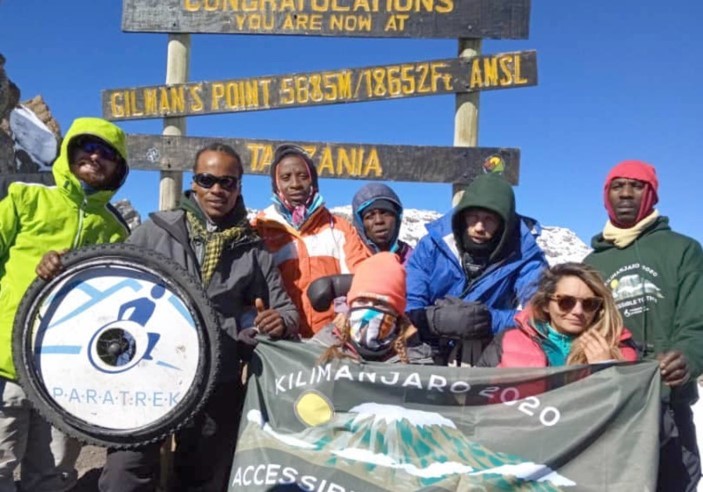
James Lassner, Executive Director of Friends of Access Israel, and the creative mind behind the Kilimanjaro expedition, notes, “Every day, people with disabilities face many personal ‘mountains to climb,’ some visible, but most hidden. They are no different than anyone else, as they have the same dreams, desires, hopes and aspirations, including ‘bucket list items.’ We at Friends of Access Israel are so proud of the accomplishment of all of the individuals that joined us to make up our diverse FAISR Kilimanjaro Family. United together, they used their collective physical strengths, mental toughness, diverse abilities, musical/dancing talents and humour to make each inch of Kilimanjaro accessible together!”
Karen Tamley, President and CEO of Access Living is similarly proud of what the group accomplished and what the trek represents. “Growing up as a wheelchair user, I sat on the sidelines and was never able to participate in sports or recreation with my peers. This trip, which includes climbers both with and without disabilities, shows me how our society is becoming more inclusive and accessible for people with disabilities. This trip represents the pushing of the boundaries toward a more inclusive world where hikers/climbers with and without disabilities can meet this meet this incredible challenge together. This trip represents the ways in our world can become a more accessible for everyone in all aspects of life.”
Omer Tzur, Parartrek’s founder, reflected on the Kilimanjaro experience. “Ascending the peak of Kilimanjaro is a dream come true not because of the mountain. That was never a dream of mine. The dream that we fulfilled is to see this group, people with and without disabilities - and major ones - climbing up together, as a group, as people who see each other as equals. To see that, out there in a super non-accessible trail, for me, is a reason to continue doing what we do!”